
Parish Church
About the church
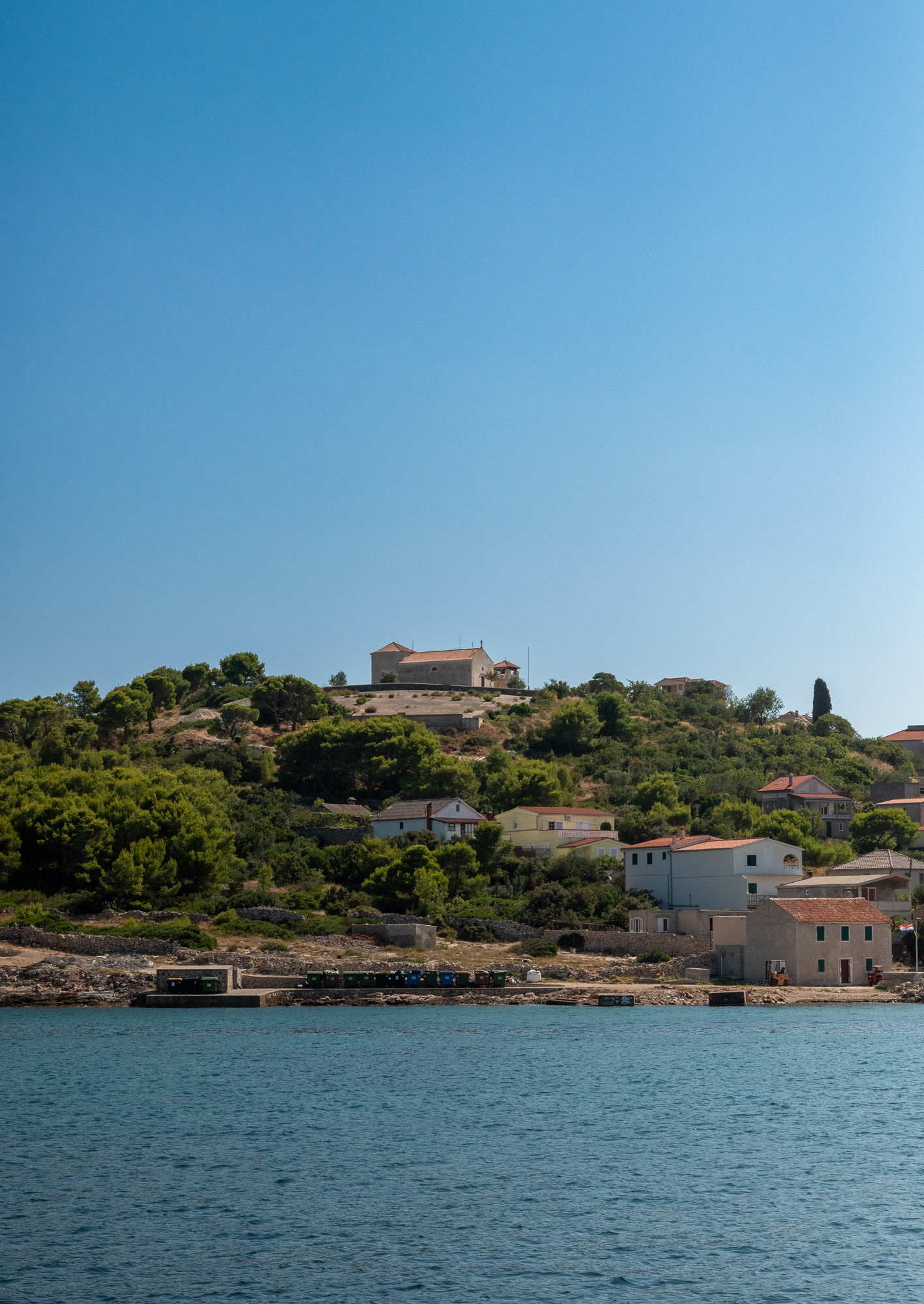
The Parish Church of the Holy Trinity on Vrgada has been granted preventive protection as a cultural heritage site (2022–2026).
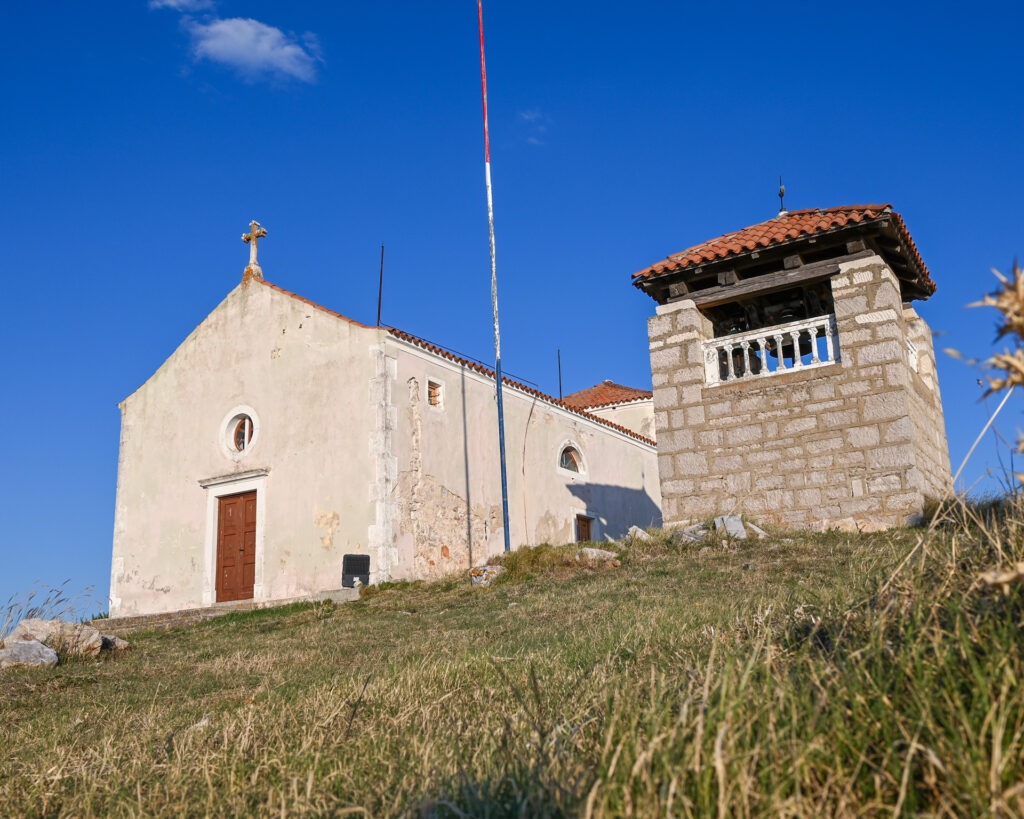
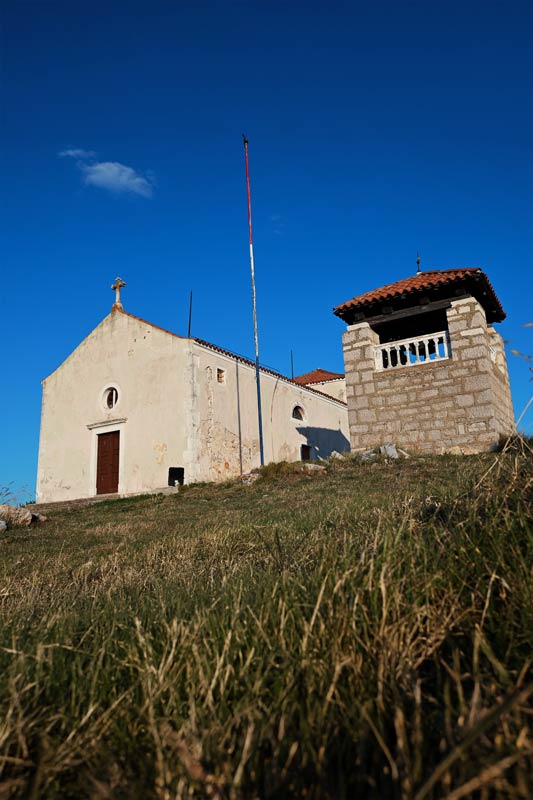
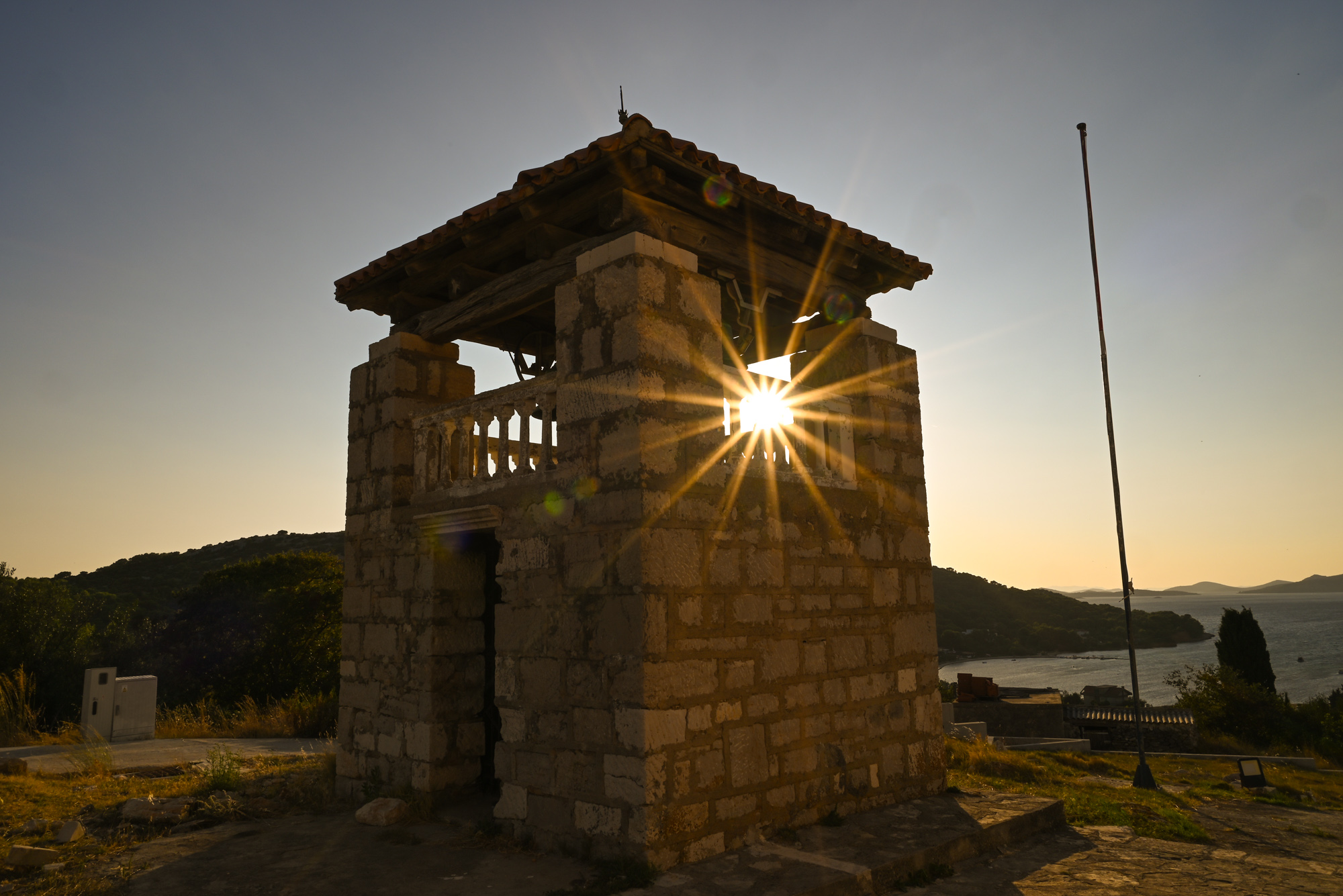
The Parish Church of the Holy Trinity is a Baroque structure completed in 1687, and it was probably under the patronage of the Damiani family, who had received the island of Vrgada as a feudal possession somewhat earlier. Previously, the role of the parish church had been performed by the Church of St. Andrew, near which a cemetery was also located. Due to the likely increase in population, a new and more spacious parish church was built on Sudujam Hill. At this site, rare ancient finds and later burials have been recorded. Therefore, it is possible to assume that an earlier cult building once stood on the hill, although further research will be required for more definitive conclusions. The existing Baroque church has an unusual form, consisting of a cylindrical sanctuary space with an external diameter of about 8.5 m, and a longitudinal rectangular nave with external dimensions of 14.5 m in length and 7.5 m in width. The sanctuary section, oriented to the east, has a central circular form and is topped by a dome resting on a prominent profiled cornice in the interior. To the west, a rectangular church space adjoins it, which at the junction with the apse is framed by a profiled triumphal arch supported by two side pilasters, a typical Baroque architectural solution. The church has relatively few openings: a simple portal with a profiled cornice, an oculus above it, a side entrance, one thermal window on each side, and two smaller windows in the sanctuary. The exterior is completely plastered, while the preserved stone decorative elements include a small acroterion at the top of the roof and a stone cross on the façade, which probably replaced an earlier bell gable. A bell tower, or small bell loggia, was built in the immediate vicinity of the church at the beginning of the 20th century. The interior of the church is also plastered and fitted with newer floor covering. In the sanctuary—previously separated from the nave by a small Baroque balustrade—there is the main altar, which divides the central space into a front sanctuary area and a small sacristy behind it. The church contains valuable Baroque altars and a later built wooden choir gallery.
❶ Main altar with painting and tabernacle
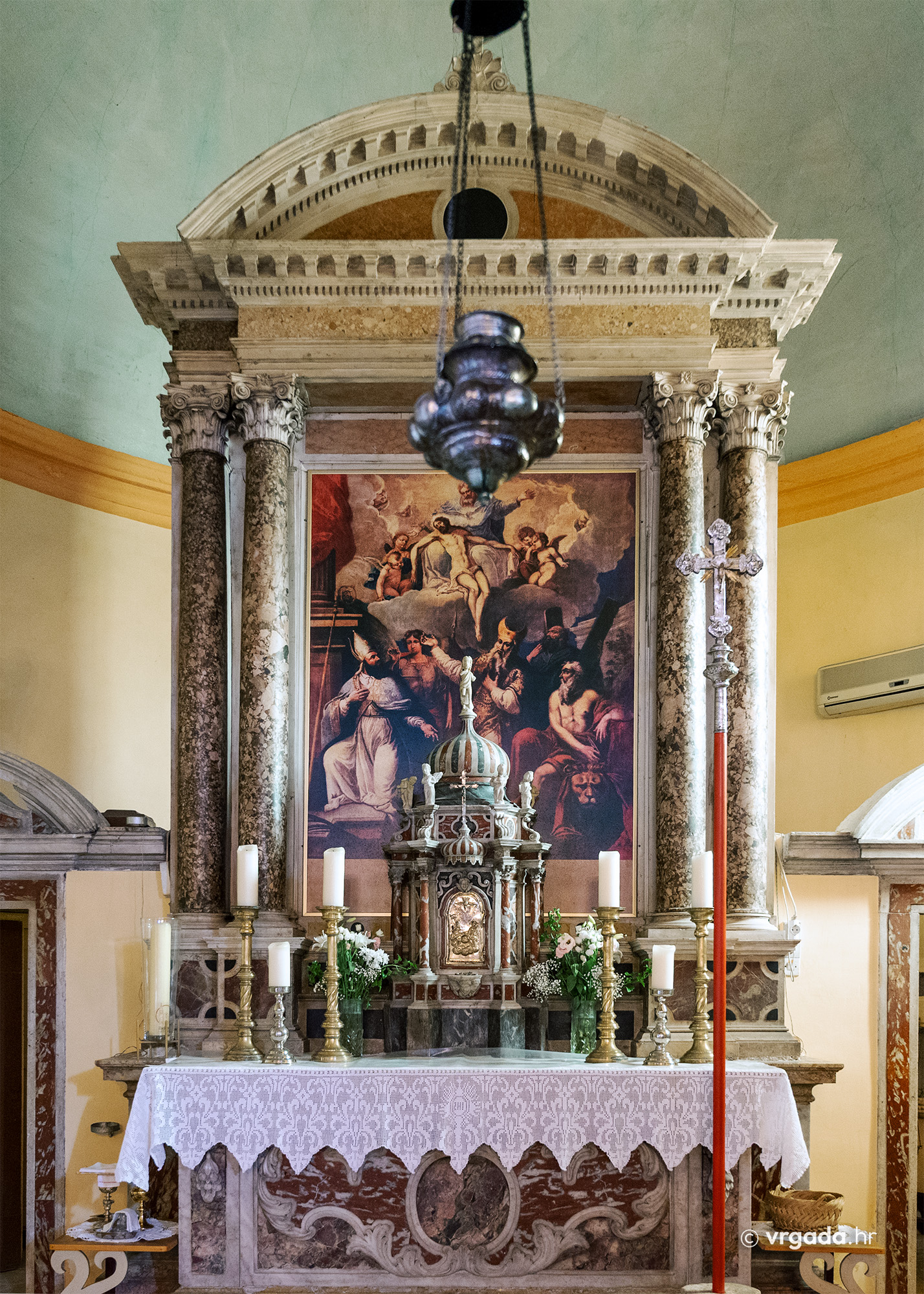
The main altar of the parish church, made of marble with multi-coloured inlays, consists of an older section – a Baroque altar mensa and tabernacle from the second half of the 18th century – and a classicising upper section (retable) with columns dating from the late 19th century. The lower part of the altar and the tabernacle, executed with very high craftsmanship, are the work of the local altar-making workshops Dell’Aqua and Degan, known for the numerous altars they produced for churches on the Zadar islands. The upper part of the altar was once made of wood with gilded columns, but due to deterioration it was later replaced with a marble structure. The altar ensemble also includes the side doors of the sacristy with decorative overdoor elements and sculptures of angels.
❷ The altar painting of the Holy Trinity
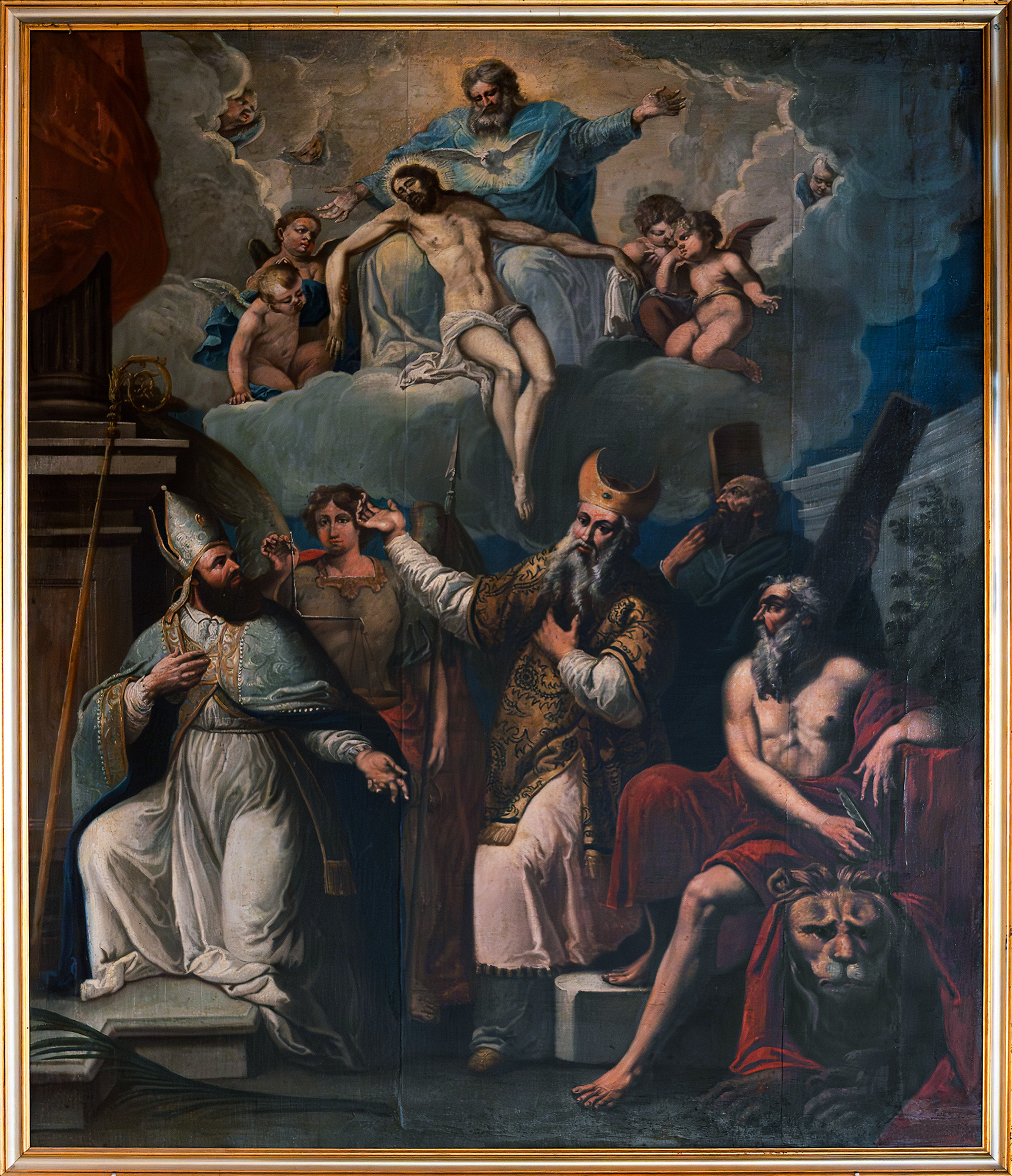
The altar painting of the Holy Trinity is an older painting placed within the rectangular frame of the newer part of the altar. It can tentatively be dated to the 17th century and attributed to an unknown Venetian Baroque painter, and it was probably commissioned when the church was completed in 1687. The painting depicts the Holy Trinity – God the Father, Christ, and the Holy Spirit – among angels in the upper part of the composition. In the lower section appear saints connected with the island of Vrgada itself as well as with the wider Zadar region to which it belongs. Shown in the foreground, from left to right, are St. Domnius, St. Simeon, and St. Jerome, at whose feet lies a lion. Between them stand St. Michael the Archangel, depicted as a young winged soldier, and St. Andrew, portrayed with an older physiognomy and holding his characteristic cross.
❸ Side Altar of Our Lady of the Rosary with a Statue of the Virgin and Child
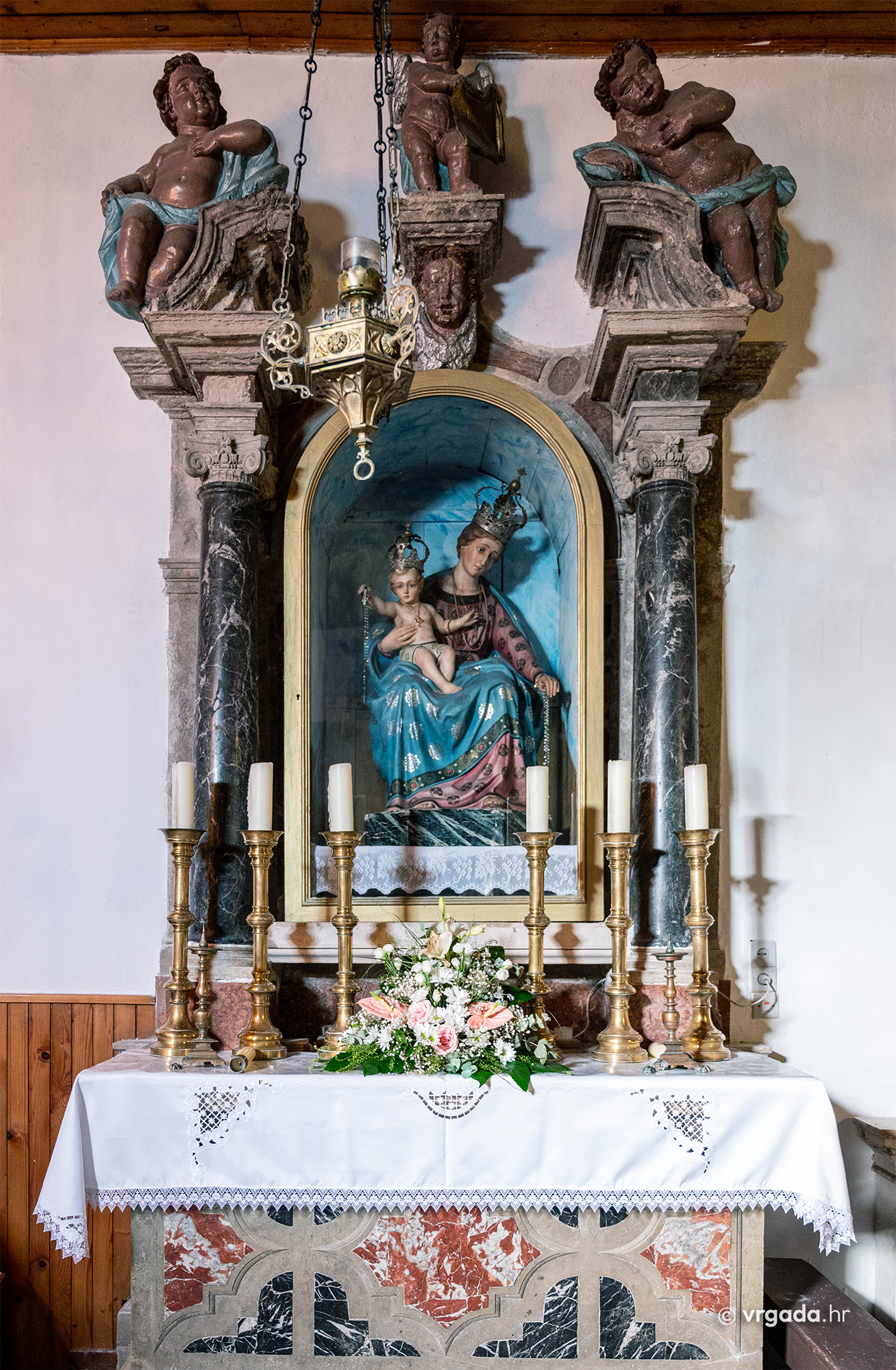
The side altar on the northeast wall, made of marble with multi-coloured inlays, was created in the mid-18th century. It is smaller in size compared to the main altar, but it is more richly decorated, particularly in its upper section, which features three full sculptures of angels and one cherub’s head. Although the sculptures have been somewhat inexpertly repainted, the altar as a whole remains a high-quality Baroque work, attributed to the master Girolamo Picco.
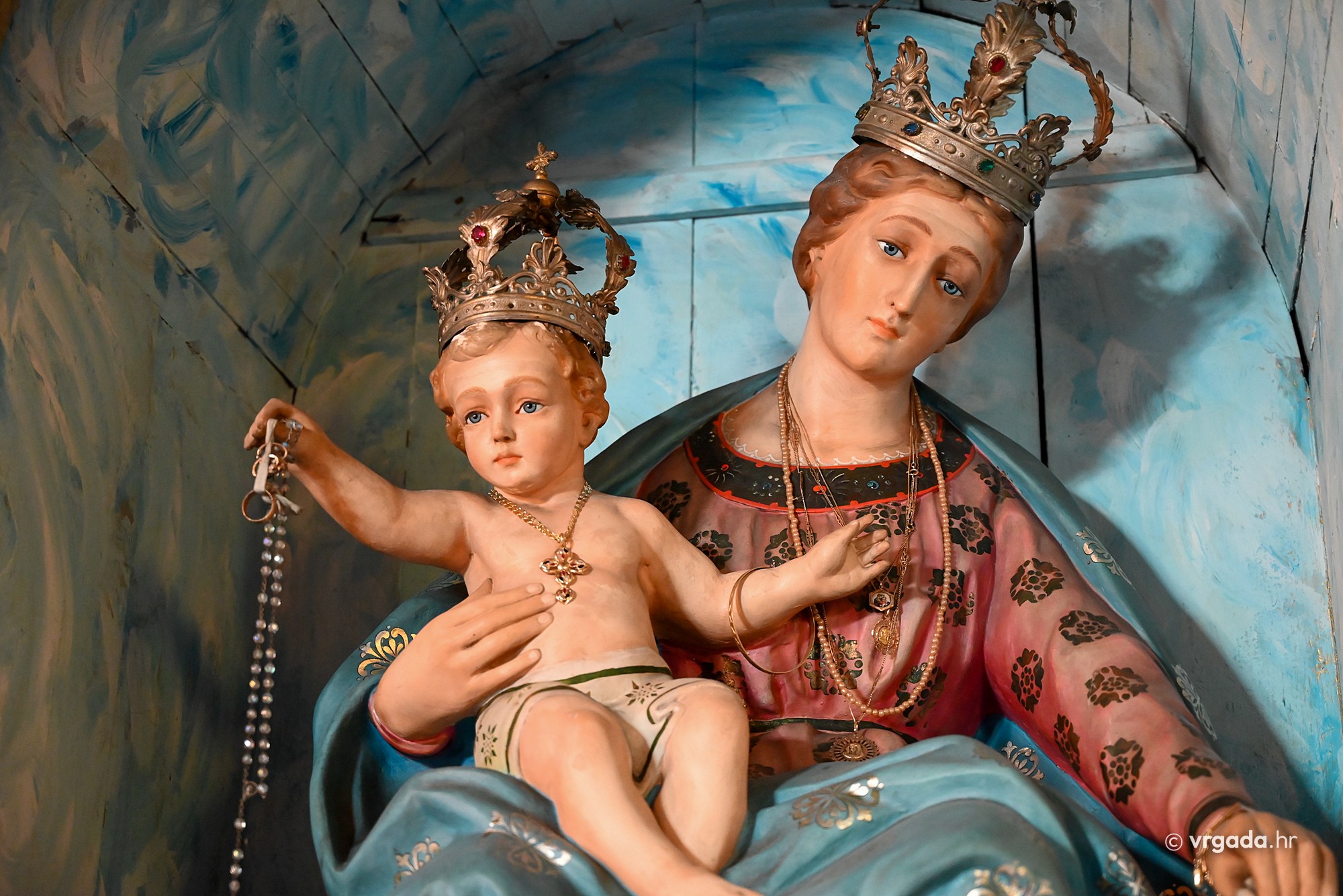
In the deep semicircular niche of the altar stands a seated statue of Our Lady of the Rosary, holding the Child Jesus on her knee. Together they extend rosaries toward the faithful. The sculpture is finely painted, with gentle facial expressions and gestures, and was probably created in the early 20th century.
❹ Side Altar of the Holy Cross with Painting
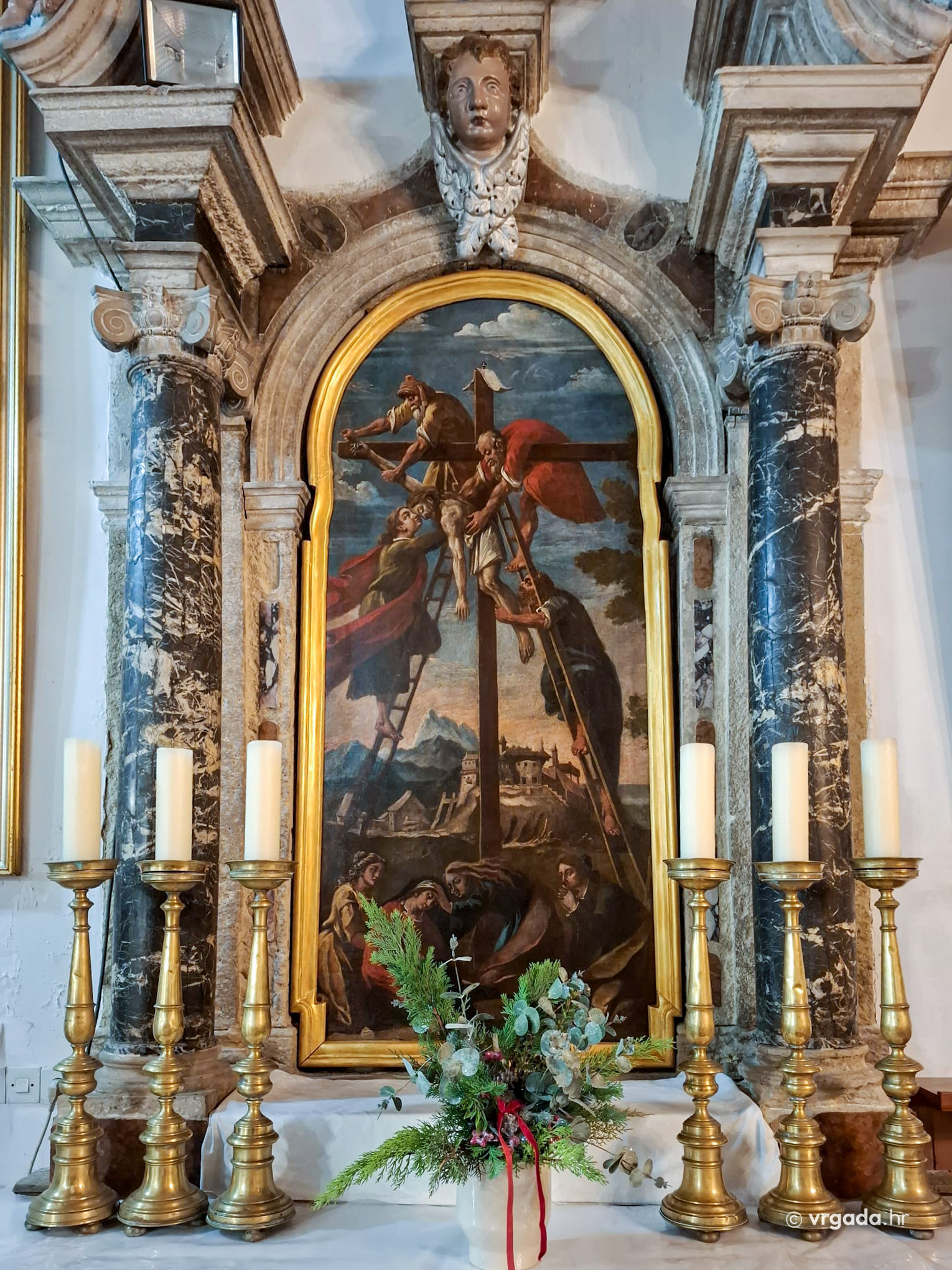
The side altar on the southwest wall shares the same characteristics as the one with the statue of Our Lady of the Rosary and was most likely made by the same master, Girolamo Picco, in the mid-18th century. As with the previous altar, the lower section is simpler, while the upper part is more richly articulated, with columns of black marble and three sculptures of angels and a cherub’s head, which have been somewhat inexpertly repainted.
At the centre of the altar, within an arched frame, is a painting depicting the Deposition of Christ from the Cross, the work of an unknown Venetian painter, probably dating from the late 18th century. In a dramatic and somewhat rustic manner, the scene shows four men removing Christ’s body from the cross, while four women gather beneath them, among whom are the Virgin Mary and Mary Magdalene. The background is filled with a broad expanse of sky with clouds and a mountainous landscape with sharp peaks, as well as the depiction of a small town in the lower part of the composition.
❺ Processional Cross
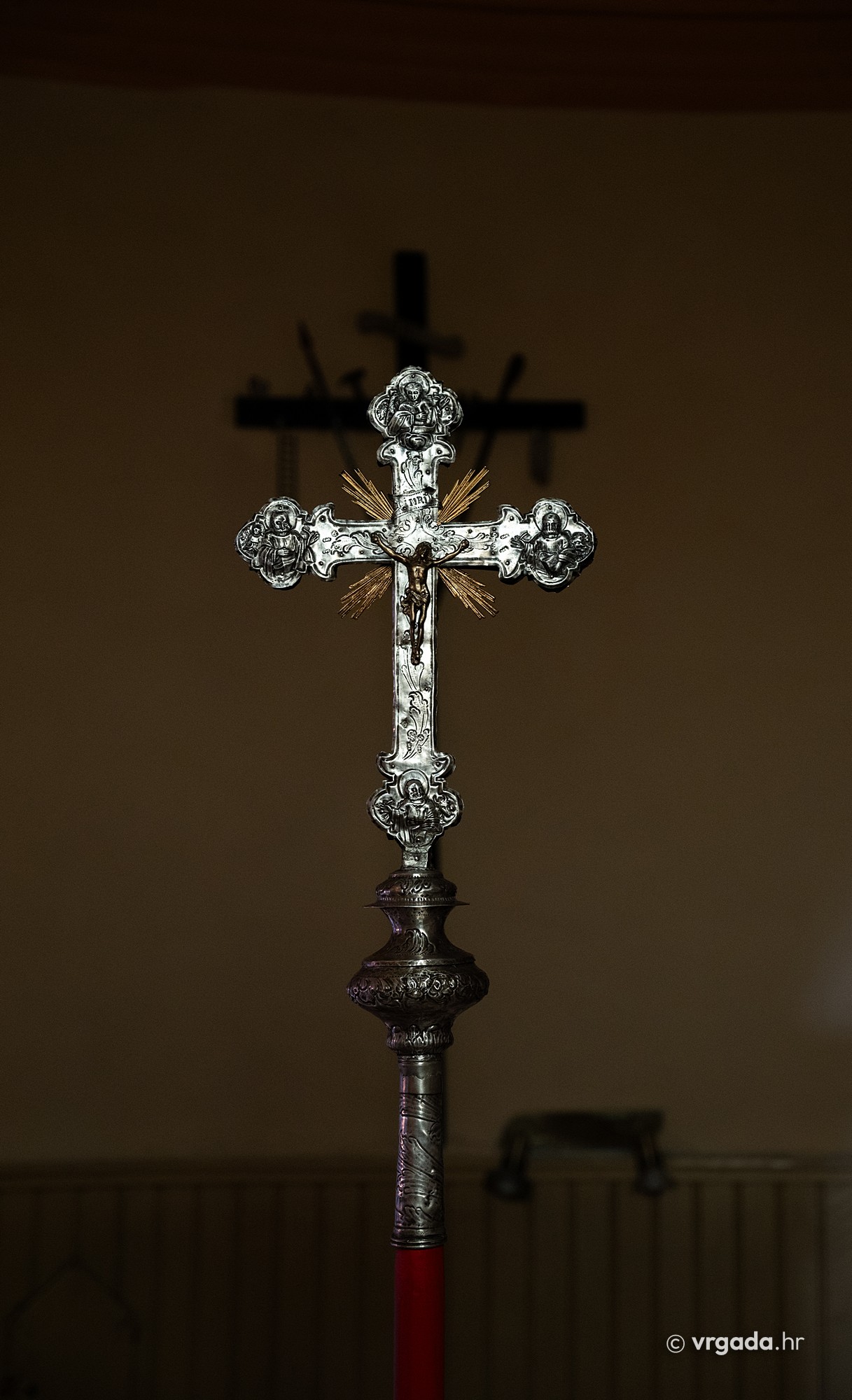
The processional crucifix is made of silver sheet mounted on a wooden base, decorated using repoussé and engraving techniques. The handle is richly ornamented with floral motifs, while the cross itself ends in trilobed extensions that form enlarged terminals designed to hold relief half-length figures of the Evangelists. The figures are arranged as follows: John the Evangelist at the top, Luke the Evangelist at the bottom, Mark the Evangelist on the right, and Matthew the Evangelist on the left. At the centre is the corpus of the crucified Christ, framed by radiating rays. The style of the relief figures and decorative elements points to the Baroque period and suggests Venetian workshops as the place of production, similar to other comparable examples preserved in the Zadar region.
❻ Statue of the Virgin and Child
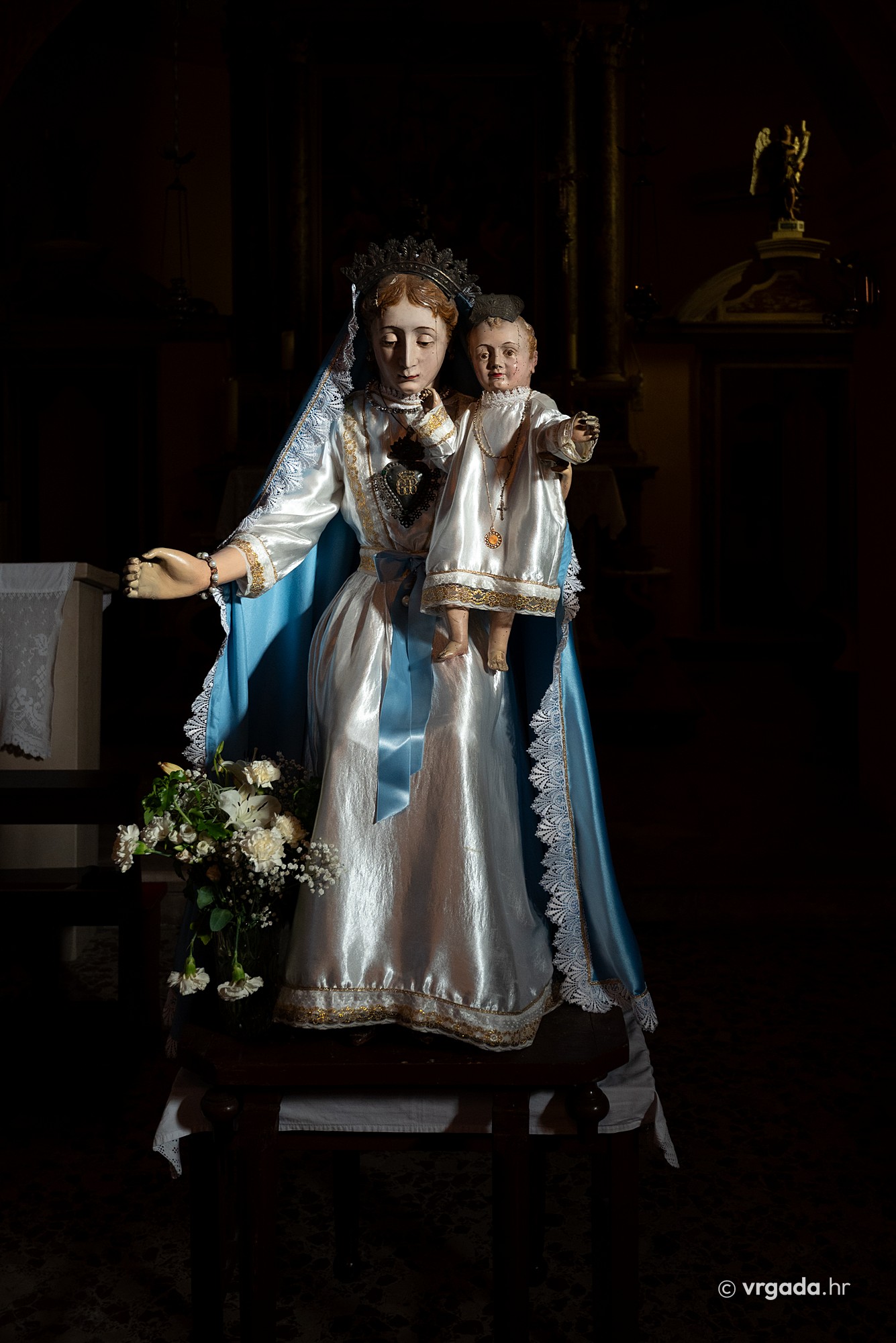
The seated statue of the Virgin Mary is made of wood and polychromed, and was probably created in the 19th century. Like other statues intended to be dressed and displayed, it is likely that only the faces and hands were more carefully carved, while the rest of the body was simplified to accommodate garments. The Virgin Mary sits on a throne, supporting the Christ Child with her left hand, while her right hand is raised (it probably once held a rosary). Her face is oval with regular features, her gaze lowered, and brown hair can be seen beneath the blue veil draped over her head. Standing on her left knee is the Child Jesus, who gently extends his right hand toward his mother’s face, while his left hand is raised (it likely once held a rosary). Later additions include silver votive crowns placed on the heads of both the Virgin and Christ, and votive offerings hung around their hands and necks.
❼ Baptismal Font
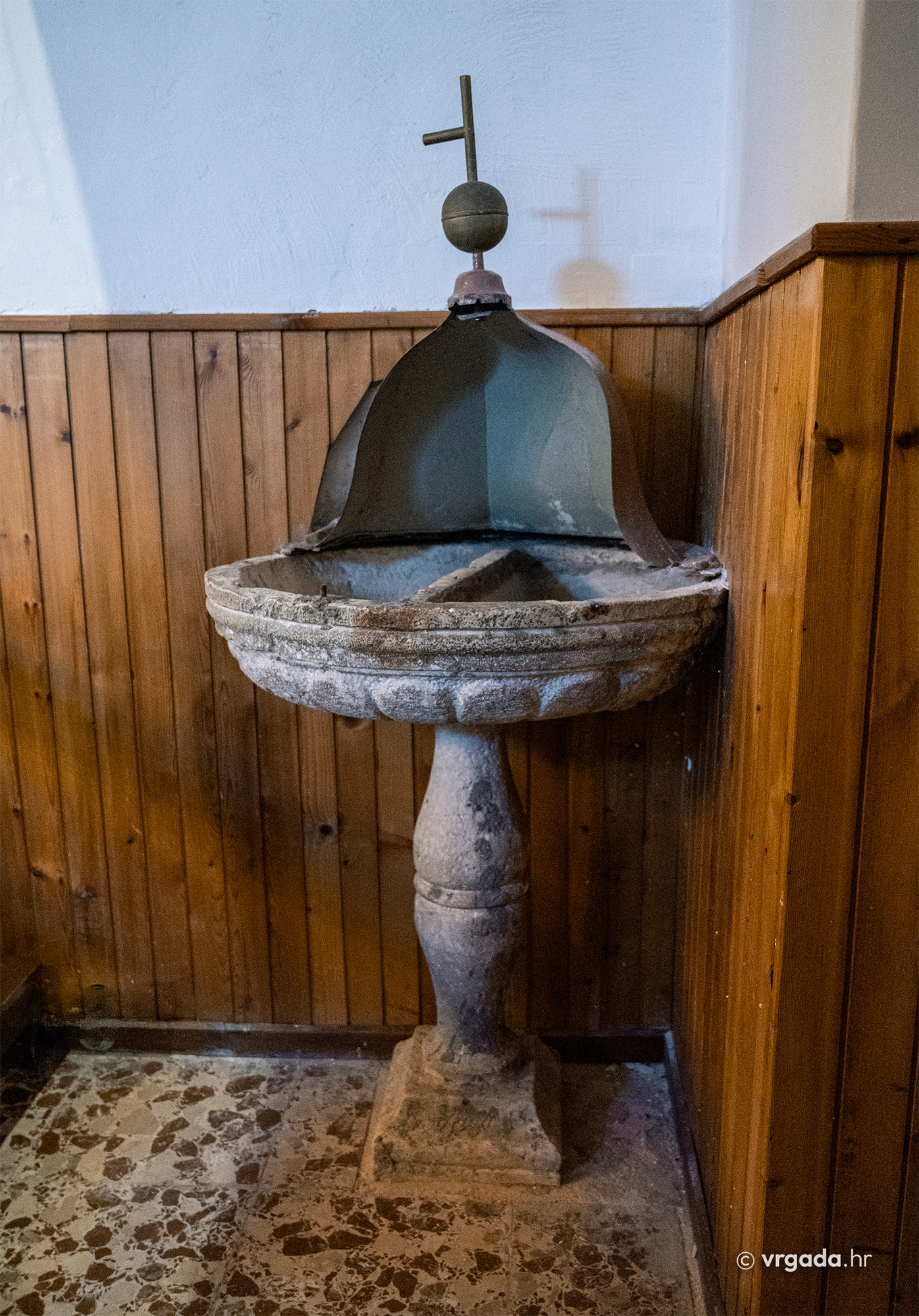
The stone baptismal font, with a metal cover, probably dates from the Baroque period, around the time the church itself was built. Decorative elements such as the fish-bladder motif on the underside of the basin and the support in the form of a baluster with a double-pear profile are characteristic design features of this type of church furnishing. Stylistically, these elements were common over a long period during the 17th and 18th centuries.